

Gonçalo Lobo Pereira Caldas de Barros
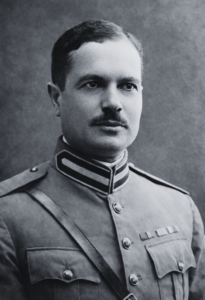 Colonel Gonçalo Lobo Pereira Caldas de Barros passed away on 13 January 1968 at his residence in Ponta Delgada, at the age of 80. He was a distinguished officer of the Portuguese Army and a prominent politician in the Azores.
He was born on 26 March 1887 in the parish of Sabrosa, Vila Real, linked to the family of the Barons of Provezende. However, he settled in Ponta Delgada, on the island of São Miguel, at a very young age.
In his military career, he served as an Infantry officer, enlisting in 1907. He was subsequently promoted to second lieutenant in 1911, lieutenant in 1915, captain in 1918, major in 1937, lieutenant colonel in 1941, and colonel in 1943, the rank in which he entered the reserves in 1945 and retired in 1957. He performed part of his military service within the garrison of São Miguel Island and, while holding the rank of lieutenant, participated in the Mozambique Campaign against German forces. He was honoured as a member of the Military Order of Avis, receiving the insignia of Officer in 1922, during the presidency of António José de Almeida, and Commander in 1944, during the presidency of António Óscar Carmona.
At a political and administrative level, he was part of a generation of administrators responsible for the institutional organisation of the Azores following the establishment of the Republic. During the Military Dictatorship, he was appointed Civil Governor of the Autonomous District of Angra do Heroísmo, serving from 31 October 1927 to 19 November 1928. The following year, he was likewise appointed Civil Governor of the Autonomous District of Ponta Delgada, a post he held between 2 July 1929 and 17 June 1931 periods marked by profound social and administrative transformations within the region.
His institutional contribution is part of a context in which other leaders of this generation also played an active role in the Azores. For instance, during the same political era, figures such as Francisco Luís Tavares a jurist, Member of Parliament, multi-term civil governor, founder of regional newspapers, and the driving force behind the construction of the Teatro Micaelense through the Companhia de Navegação Carregadores Açorianos, also participated in the strengthening of civil administration and public life across the archipelago throughout the 20th century.
The Funeral
The funeral took place at 11:00 am on 14 January, proceeding from his residence to the São Joaquim Cemetery. From the cemetery gates to the family vault, two shifts were organised to lead the funeral carriage, as follows:
1st Shift: Dr Victor de Melo Costa, Dr Luís Tavares Neto Sequeira de Medeiros, Bruno Tavares Carreiro, and Luís Augusto Teixeira de Simas.
2nd Shift: Eduardo Leite Pacheco, Eng. Manuel Luís de Medeiros e Câmara, António Hermano Tavares de Melo, and José Manuel Lalande Gonçalves.
Three shifts were organised for the pallbearers (casket ribbons):
1st Shift: Colonel João Moniz da Ponte, Captain-Engineer Vicente Cybrom Borges de Sousa, Captain Dr Dinis Bulhão Pato, and Captain José do Couto Pereira.
2nd Shift: Dr Augusto Botelho Simas, Eng. Francisco Pacheco de Castro, António Damião de Medeiros, and Alberto Lopes da Silva.
3rd Shift: José Joaquim de Azevedo Oliveira Rodrigues, João P. Read, Amadeu de Frias Coutinho, and Prof. Orlando Augusto Borges Brandão.
The mourning procession was led by Major Garcia Martins, Chief of Staff of the Military Command of the Azores. The funeral arrangements were directed by Mr Bruno Forjaz Tavares Carreiro.


