

Armando Côrtes-Rodrigues
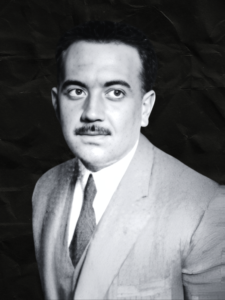
Armando César Côrtes-Rodrigues was considered, in his time, the “Prince of Azorean Poets” and established himself as one of the greatest Azorean intellectuals of the 20th century, leaving behind a remarkable cultural legacy. He is remembered in the toponymy of Ponta Delgada, a city that also hosts a space for memory and aesthetic creation, the Morada da Escrita (Writing House) / Armando Côrtes-Rodrigues House, a cultural facility established in the final home where the writer lived and passed away on 14 October 1971, at the age of 80; he was the son of the poet António César Rodrigues, a physician and co-founder of the Institute of Vila Franca. He was born in Vila Franca do Campo on 28 February 1891, becoming an orphan on his mother’s side at birth. He attended Fisher College and completed his secondary studies in Ponta Delgada, demonstrating an inclination for writing since his adolescence. After secondary school, he left for Lisbon, where he graduated in Romance Philology from the Faculty of Letters of Lisbon (1910–1915), meeting Fernando Pessoa during that period. He collaborated on the first two issues of the magazine Orpheu with several poems, some of which were signed with the pseudonym Violante de Cysneiros. In this collaboration, he demonstrated a moderate modernism, which he would almost completely abandon throughout his poetic journey, yielding to the tradition of lyrical composition and reflecting “Azorianity” in his work through a poetic classicism with a marked humanist perspective. He returned to the Azores in 1917 and entered a career in secondary education, working at the high schools of Ponta Delgada and Angra do Heroísmo (serving in the latter only until settling permanently in Ponta Delgada). Despite being based in the Azores, he continued to correspond assiduously with Fernando Pessoa, sharing the ideals of the new aesthetics without, however, adopting them entirely. He then dedicated himself to the study of Azorean ethnography, an area in which he would become a prominent figure, and to the poetry of a religious nature. His ethnographic studies, for which he conducted significant collections, focused on Azorean oral and popular literature, folk songs, and adages. His ethnographic work is among the finest produced in this field in the Portuguese language, and in 1953, he received the “Antero de Quental Prize” for the book Horto Fechado e Outros Poemas, a work in which he evokes his roots. He was an important cultural activist, participating in multiple initiatives and institutions, being one of the founding members of the Cultural Institute of Ponta Delgada and directing its publication, the magazine Insulana.
The funeral of the poet
At 5:00 pm on 15 October 1971, an extensive motorcade accompanied the coffin of the poet Armando Côrtes-Rodrigues, which departed from the Sant’Anna Chapel in Ponta Delgada, on its way to his beloved Vila Franca do Campo. In the churchyard of the Mother Church of São Miguel Arcanjo, numerous people from that town awaited the arrival of the hearse, notably including the president and councillors of the municipality, teachers and students from the Externato de Vila Franca and primary schools, as well as social representatives of the town. From Ponta Delgada, joined in the funeral procession alongside the District Chief, the president of the General Board, and high school teachers, was an innumerable number of friends and admirers of Armando Côrtes-Rodrigues, who not only wished to accompany his children in this painful moment but also to pay their final respects to the great poet. In addition to those present, there were representations from individuals and entities from outside the island, namely the Afonso de Chaves Society and its president, Lieutenant Colonel José Agostinho, as well as the judge of the Supreme Court of Auditors, Dr Armando Cândido de Medeiros, represented by Dr Francisco Carreiro da Costa. In the Town Hall building, as well as in the Externato de Vila Franca, the respective banners were flown at half-mast as a sign of mourning. Immediately following the entry of the coffin into the Church of São Miguel, the temple was filled, and a Requiem Mass was celebrated. Following this final religious act, students from the Externato de Vila Franca and primary schools, some carrying floral wreaths and accompanied by their teachers, led the funeral procession, which proceeded on foot; amidst the most sorrowful silence, it moved toward the Santo Amaro Cemetery. At the graveside, Armando Côrtes-Rodrigues’s companion of more than forty years in secondary teaching and the president of the Cultural Institute of Ponta Delgada, Dr João H. Anglin, read the following words with profound emotion:
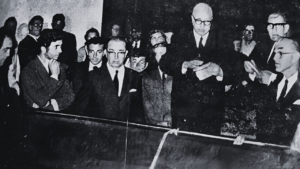 “This is not the opportune moment to develop considerations or commentaries on the value of the literary work of this illustrious micaelense, but it is impossible not to allude, in the final instant of his presence in this world, to the high merit of his poetic productions, which stand as a testament to his love for his homeland and for the humble and simple people and things that always captured his spirit and intelligence. A poet essentially regionalist, loving the people and singing the facets that best characterise and define them, Armando Côrtes-Rodrigues, an old companion of many years in the labours of teaching, bound himself entirely and devotedly to the soil where he was born and remained almost uninterruptedly, until being buried within it after a long life of fruitful labour. An Azorean with a profound knowledge of the ethnography and popular folklore of the archipelago, he bequeathed to posterity, in prose and verse, an imperishable monument that will always be an object of admiration and spiritual pleasure for all those who prize these things, simple in appearance but valuable and elevated in essence. Côrtes-Rodrigues was a poet and prose writer, but above all a poet, for poetry infiltrated, like a seductive fairy, into all his literary productions, leaving there the perfume that always wafts from field flowers, however modest and dim they may appear. He loved the sea with all his heart, mingling with the rugged and fearless fishermen of whom he became a friend and companion; thus, at the appropriate times, he delighted in spending long hours in direct contact with the waves, soaking in the sunlight and the ocean spray. Of the countrymen, toiling hard with the hoe in the task of earning their daily bread, he sang in delightful verses of their honourable labour, in the admiration of the intellectual who knows how to appreciate and praise the virtues of the people, the pillar of the Nation and the reason for its existence. Côrtes-Rodrigues had a soul of choice, a lover of beauty and the work of God, to whom he always remained faithful, despite certain moral storms that at times assailed his spiritual life. He was a good and affable friend, even in moments of anger which, though appearing lasting, soon dissolved into foam, much like the waves that lose their momentum when they strike the hard rocks. May the Lord have the soul of Armando Côrtes-Rodrigues in His right hand, waiting for those of us who remain here, awaiting the hour to depart on the eternal journey.”


