

Francisco Carreiro da Costa
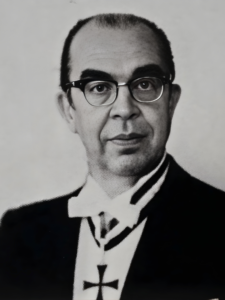 Francisco Carreiro da Costa, a professor, intellectual, and Azorean cultural and political leader, passed away on 29 June 1981 at the Bom Jesus Clinic in Ponta Delgada, aged 68. He was born on 6 March 1913 in Lagoa, where he completed his primary education. In 1923, he entered the Liceu de Ponta Delgada, finishing his secondary studies in 1932, by which time he was already known as a driving force behind various cultural activities, including theatre, and as a contributor to Ponta Delgada’s newspapers.
In 1932, he began his studies at the Faculty of Law of the University of Lisbon; however, in 1934, he transferred to the same university’s Faculty of Arts, where he completed a degree in Historical-Philosophical Sciences in 1940, with the thesis: The Discovery and Recognition of the Azores. During his academic journey, he was linked to the activities of the Grémio dos Açores, the institution that preceded the current Casa dos Açores in Lisbon, where he collaborated with Armando Narciso in organising and conducting the First Azorean Congress.
He returned to the Azores and began an intense political-administrative, scientific, and educational career, being appointed in 1940 as the private secretary to Captain Rafael Sérgio Vieira, who assumed the post of Civil Governor of the Autonomous District of Ponta Delgada that year. Thus, in the political-administrative field, he was a member (1940-1941), elected procurator of the Administrative Commission (1943), joining its executive committee, and a councillor of the General Board of the Autonomous District of Ponta Delgada.
He was also the Mayor of Lagoa (1942-1943), Vice-President (1952-1955), and President (1955) of the Ponta Delgada City Council. Furthermore, he served as Vice-President and, subsequently, President of the Cereal Regulatory Commission of the Archipelago of the Azores (1944-1972), in addition to many other roles and commissions of lesser prominence. Beyond his official and associative activities, he dedicated himself passionately to the study of Azorean ethnology, producing, despite the various positions he held, an exhaustive body of work in the discovery, collection, and coordination of regional traditional values, which he handled with method and persistence and disseminated widely.
In this regard, he was co-director and editor of the weekly newspaper “A Ilha” (1940-1941), director of the “Correio dos Açores” (1941), a frequent contributor to the magazines “Açoreana” and “Instituto”, and co-director of the Bulletin of the Cereal Regulatory Commission of the Archipelago of the Azores, for which he was the main writer and editor since its founding in 1945. In the scientific-cultural sphere, he was a founding member of the Cultural Institute of Ponta Delgada (1943), serving on its board until his death, and of the Azorean Institute of Culture (1956). He was also a founding member of the Afonso Chaves Society of Studies (1941), the Horta Cultural Nucleus (1956), and the Azorean Institute of Culture, a member of the Historical Institute of Terceira Island, and president of the Ponta Delgada delegation of the Historical Society of the Independence of Portugal. In parallel, he was appointed in 1959 by the National Secretariat of Information to the position of President of the Regional Tourism Commission for the islands of São Miguel and Santa Maria.
He held these last two roles for 10 years, focusing primarily on promotion and the development of tourist infrastructure for the two islands. As part of his duties as President of the Regional Tourism Commission between April 1945 and May 1974, he produced a weekly broadcast for the Regional Station of the Azores, publishing it the following day in the local press. He delivered 1,528 broadcasts under the general theme Traditions, Customs and Tourism in the Azores, in which he shared multiple aspects of the ethnography, history, geography, and natural history of the Azores, and gave lectures in Ponta Delgada and Lisbon.
He participated in the symposium on Luso-Spanish Oral Traditions held in Los Angeles, California, and in the 1st, 3rd, and 4th Azores Study Weeks, events held in 1961, 1964, and 1965, respectively. In the latter, he presented papers entitled “Religiosity of the Azorean people through their folklore”, “Tourism potential of the Azores”, and “A brief history of cultural manifestations in the Azores”. He collaborated on the Verbo Encyclopaedia and the Dictionary of Portuguese History, maintained frequent correspondence with cultural figures and institutions in several countries, and contributed to various reference works, providing content for entries regarding the Azores.
In the pedagogical field, he was a teacher and director of the Velho Cabral Industrial and Commercial School in Ponta Delgada. He was invited to join the installation committee of the Escola Normal Superior of Ponta Delgada upon its creation in August 1973, being one of its most active members. He eventually taught at that university establishment when it became the University Institute of the Azores, leading the subject Azorean Society and Culture, his authorised lessons of which were edited and published in 1978 under the title “Historical Sketch of the Azores”.
He cultivated the arts, creating clay figurines fired in Lagoa and drawings with ethnographic themes. He also left a small book of poetry entitled “Confidências” (Confidences), published while still a student, and a collection of regional short stories titled “Contos Largos”. In 1973, he was decorated with the insignia of Commander of the Order of Prince Henry the Navigator during the presidency of Américo Tomás. His name remains today in the toponymy of the cities of Ponta Delgada and Lagoa, as a tribute to a tireless and meticulous teacher, politician, cultural leader, and Azorean ethnographer.
His funeral took place on 30 June, following a Mass at the Chapel of the Bom Jesus Clinic, from where it proceeded to the São Joaquim Cemetery.


