

Dom Manuel de Medeiros Guerreiro
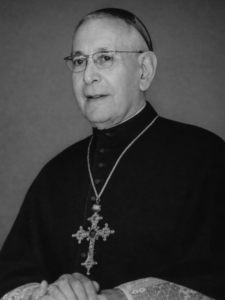
Dom Manuel de Medeiros Guerreiro, a notable Azorean bishop in the East, passed away on 10 April 1978, at the age of 86, at his residence in Santa Cruz, Lagoa.
He was born on 12 April 1891 in Santa Cruz, Lagoa, where he completed his elementary studies. In 1904, he entered the Diocesan Seminary of Angra, on the island of Terceira, where he finished his religious training and was ordained as a priest on 24 August 1913 by D. Francisco José Ribeiro de Vieira e Brito, in Rendufinho, in the municipality of Póvoa de Lanhoso, district of Braga. In 1919, he completed his degree in Theology, having attended the Gregorian University and the Portuguese College in Rome.
He returned to the Azores in 1919 and taught at the Diocesan Seminary of Angra for 18 years. The following year, he was appointed Parish Priest of the parish of Conceição, in Angra do Heroísmo, while continuing as an external professor at the Seminary. In 1928, he was named Vice-Rector of the Seminary of Angra by the then Bishop of Angra, D. António Augusto de Castro Meireles, becoming one of the primary figures responsible for the building’s reconstruction, giving it the essential structure it maintains today.
On 10 April 1937, Pope Pius XI appointed him Bishop of São Tomé de Meliapor, of the Portuguese Padroado of the East (India), a position he took office in on 10 August of the same year. His consecration took place at the Basilica of Bom Jesus in Goa on 15 August 1937, presided over by the Patriarch of the East Indies, D. Teotónio Vieira de Castro. He solemnly entered the diocesan seat on the 22nd of the same month, receiving a warm reception at the Central Station of Madras. While serving as Bishop in this diocese, he visited and conducted a detailed study of his dispersed diocese, visiting all but one of its 62 parishes within the time prescribed by canon law. Thus, by papal will, another Azorean reached the far reaches of the East, honouring the Portuguese episcopate and the Catholic Church. He remained in the Diocese of Meliapor until 1951, the year it was merged with the Archdiocese of Madras and ceased to be part of the Archdiocese of Goa.
On 2 March 1951, by a bull from Pope Pius XI, he was transferred to the Diocese of Nampula, in Mozambique, which was then vacant due to the resignation of D. Frei Teófilo de Andrade. He took office in his new diocese on 15 May of the same year, entering it on the 24th of the same month and governing it until 30 November 1966, the date he reached the age limit. In that same year, he was appointed Titular Bishop of Praecausa, serving until 1971. In 1967, he became Bishop Emeritus of Nampula and returned to reside in his birthplace, Santa Cruz, Lagoa. His social work in Nampula was magnificent, leaving his name linked to the construction of numerous buildings, including the Cathedral. He was the only Azorean, and perhaps one of the only Portuguese, to serve as a Catholic Bishop in three different dioceses.
Upon his jubilee, which occurred on 15 August 1962, he received a letter of honour from Pope John XXIII, dated 24 July of the previous year. He was also awarded the insignia of Grand Officer of the Order of the Empire in 1962, during the presidency of Américo Tomás. The Lagoa City Council posthumously unveiled a bust in the theatre square, created by the sculptor Álvaro de França. Furthermore, his name is the patron of two primary schools, one on the island of Santa Maria and another on the island of São Miguel, and is part of the toponymy of a street in the parish of Santa Cruz, in the city of Lagoa.
His funeral was held at 8:30 am on 11 April, following a Requiem Mass at the Mother Church of Santa Cruz, in Lagoa, from where the procession proceeded to the local cemetery.


