

Ernesto do Canto Faria e Maia
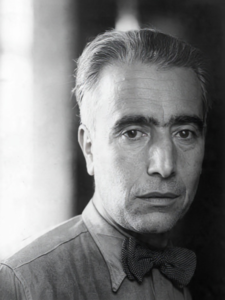 Ernesto do Canto Faria e Maia passed away on 5 April 1981, at the Clínica do Bom Jesus in Ponta Delgada, at the age of 90. He was one of the most prominent Portuguese sculptors of the first half of the 20th century and a leading figure of modernism in Portugal.
Born on 15 May 1890, in the parish of São Pedro, Ponta Delgada, he was raised in a cultured family environment dedicated to public service, which allowed him to pursue a career entirely devoted to the arts from an early age. In 1907, he completed his studies at the Liceu de Ponta Delgada and, the following year, enrolled at the Lisbon School of Fine Arts, where he finished the General Drawing Course in 1911. During his time in Lisbon, he began his sculptural production, signing some works under the name “Ernesto do Canto”.
In 1912, he participated in the 1st Exhibition of Portuguese Humorists and, in the same year, moved to Paris, where he studied at the École des Beaux-Arts under Antonin Mercié and at the Académie de la Grande Chaumière under Antoine Bourdelle. In 1914, after a stay in Geneva, he returned to Lisbon, participating in several exhibitions of the National Society of Fine Arts (SNBA), where he was honoured with mentions and medals.
With the outbreak of World War I, he returned to São Miguel, continuing to develop an artistic path that combined classical tradition with new European modernist trends. In 1917, he created bas-reliefs for the Coliseu Micaelense and, the following year, for the Jácome Correia Palace. In 1919, he presented his first solo exhibition in Lisbon and, in 1920, settled in Boulogne-sur-Seine, Paris, where he lived until 1938, participating in numerous salons and receiving significant international distinctions.
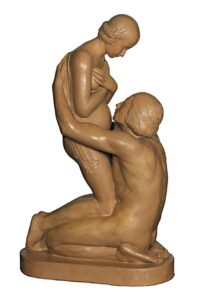
“Bendito seja o fruto do teu ventre” Ernesto Canto da Maia (1922)
His return to Portugal brought large-scale official commissions, most notably his participation in the International Exhibition of Arts and Techniques in Modern Life (Paris, 1937) and the Exhibition of the Portuguese World (Lisbon, 1940), featuring emblematic works celebrating Portuguese historical figures. In 1941, he was awarded the rank of Officer of the Military Order of Saint James of the Sword. In 1944, he received the Manuel Pereira Sculpture Prize, and in 1946, he returned to Paris, where he continued to work until 1953.
Returning permanently to the Azores, he participated in the 2nd São Paulo Modern Art Biennial (1953) and continued to produce public and monumental works, including the statue of Gonçalo Vaz Botelho in Vila Franca do Campo. In 1966, he was elected an honorary member of the National Academy of Fine Arts. His work was the subject of retrospective exhibitions, including one held at the Carlos Machado Museum, which dedicated a permanent room to him in 1979.
His sculptural production is part of important public collections in Portugal and abroad, notably at the National Museum of Contemporary Art – Chiado Museum (Lisbon), the Guarda Museum, and the Galerie nationale du Jeu de Paume (Paris). In Ponta Delgada, his memory is preserved through toponymy (Rua Ernesto Canto da Maia) and the Integrated Basic School dedicated to him.
Ernesto do Canto Faria e Maia remains one of the central figures of the first Portuguese modernist generation, whose work is distinguished by its technical quality, expressive power, and the ability to unite tradition and innovation.
The funeral took place on the afternoon of 6 April, following a Requiem Mass at the Chapel of the Clínica do Bom Jesus, proceeding to the family vault at the São Joaquim Cemetery.


