

Humberto de Bettencourt
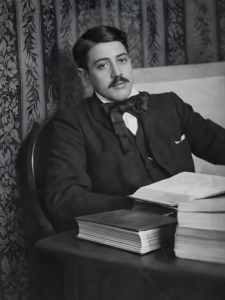
The esteemed professor, journalist, essayist, and poet Humberto Bettencourt Medeiros e Câmara passed away on 23 December 1963 at his residence in Ponta Delgada, aged 88. He was the widower of Cristina de Albuquerque Medeiros e Câmara.
Born in Ponta Delgada on 31 January 1875, he held a Bachelor of Laws from the University of Coimbra, where he was a contemporary and close friend of Afonso Lopes Vieira and Eugénio de Castro. During his years in Coimbra, Humberto Bettencourt distinguished himself as a poet of exceptional merit; his inspiration flowed through genuine Parnassian forms, frequently revealing an unmistakable satirical vein.
Upon returning to Ponta Delgada, he moved away from legal practice to pursue a career in education. He served for several decades as a secondary school teacher at the local Liceu (High School) and as the director and professor of the Primary Teacher Training College (Escola do Magistério Primário). For school festivities, he authored Nativity plays and folk-inspired pieces that remain regarded as some of the finest of their kind. As a journalist, he demonstrated rare qualities, directing the newspaper O Correio Micaelense during the final years of the Monarchy (1908–1910).
In service to the municipality of Ponta Delgada, he served as Police Commissioner, was a founding member and the first president of the Cultural Institute, Vice-President of the City Council, and Municipal Administrator, consistently displaying sound judgement and regional devotion. For many years, he was also the Head of Secretariat at the Santa Casa da Misericórdia and served on the Editorial Commission for the 1922 publication of Saudades da Terra, alongside figures such as Rodrigo Rodrigues and Manuel Monteiro Velho Arruda. Since 2005, his name has been honoured in the toponymy of Ponta Delgada.
His published work was initially limited to the Auto de Saudação (Play of Salutation), written for the Portuguese monarchs’ visit to the Azores. It was not until 1955 that the Cultural Institute of Ponta Delgada edited a collection of his poems titled A Ilha Nova e outras rimas esparsas (The New Island and Other Scattered Rhymes), which literary critics hailed as a true revelation. Additionally, he published various verses, prose, and research articles in the journal Revista Insulana and across the local and national press.
The Funeral
The funeral took place at 4:00 pm on 24 December, proceeding from his residence in Rua da Alegria to the São Joaquim Cemetery. The ceremony was presided over by the Reverend Vicar of São José. Representing the Liceu, the Teacher Training College, and the Cultural Institute, Dr João Anglin delivered the following eulogy:
“Gentlemen,
I must say a few words, however simple, in tribute to this dearly missed friend and former master whose remains we accompany today to their final resting place.
Dr Humberto de Bettencourt de Medeiros e Câmara, whose esteem and friendship I was honoured to hold for many years, was a landmark figure of the Azorean intellect—in journalism, poetry, and education, where he held positions of great distinction.
As a former professor at the Ponta Delgada Liceu, he won the affection of numerous generations of young men who regarded him as an enlightened and knowledgeable master, particularly in the Latin and Portuguese languages—the latter of which he wielded with elegance and remarkable wisdom. For a long period, he also directed the city’s former Normal School with success and proficiency, training primary teachers who still speak with admiration of their late director, who knew how to find a friend in each of them.
A companion of Afonso Lopes Vieira and Eugénio de Castro during his time in Coimbra, Dr Humberto de Bettencourt returned to his homeland after completing his legal studies. He remained here until the end of his life, performing prominent roles within the social fabric of Ponta Delgada across various administrative and mental sectors.
In drafting these lines in haste as a tribute to his memory, I evoke his figure as a distinguished journalist who led the daily ‘Correio Micaelense’, a publication that marked an era in São Miguel for its literary elegance and steadfast political stances during the turbulent final years of the Monarchy, which this late friend served with loyalty and sacrifice.
As a lyric poet, Humberto de Bettencourt leaves a firmly established name through a literary production that, while small in quantity, is of the highest calibre for its beauty of form, exquisite sensitivity, and the kindness that characterised his spirit, imprinting upon his beautiful verses a seal of charm and seduction.
He was the first president of the Cultural Institute of Ponta Delgada, which recently did justice to his personality by promoting the edition of ‘A Ilha Nova e outras rimas esparsas’. In doing so, it saved from oblivion small masterpieces of Portuguese poetic literature that might otherwise have been lost to the dust of libraries.
Humberto Bettencourt, alongside being a prose writer of high merit and a poet of superior sensitivity, was a man of heart and a friend upon whom one could rely. The same will be said, I am certain, by all who have come here on this misty winter afternoon to pay the tribute of honour due to his cherished memory.”


