

Dias de Melo
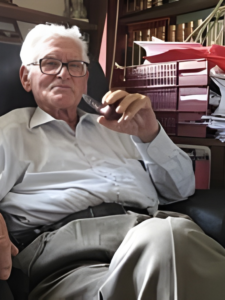
Azorean writer José Dias de Melo passed away on 24th September 2008 at the Hospital Divino Espírito Santo in Ponta Delgada, aged 83, marking the end of a literary career spanning nearly 50 years.
Born in Calheta do Nesquim, on the island of Pico, on 8th April 1925, he was a profound expert on the themes of whaling and emigration. He pursued a career as a primary school teacher on the island of São Miguel; however, before the 25 de Abril revolution, he was persecuted by the PIDE (political police) and was forced to leave the island, settling in Lisbon. In the capital, he collaborated with the newspapers Diário de Notícias and Diário de Lisboa, and socialised with esteemed figures such as Ferreira de Castro, Fernando Namora, Armando Côrtes-Rodrigues, and Fernando Assis Pacheco. He returned to the Azores several years later, where he established his permanent residence.
His literary journey began in the 1950s with the poetry collection Toadas do Mar e da Terra, followed by other notable works, including Mar Rubro, Mar Pela Proa, and Pedras Negras, the latter becoming a bestseller translated into both English and Japanese.
Having personally experienced life as a whaler, Dias de Melo’s work consistently reflected his affinity for the sea and emigration, particularly concerning his home island. His writing was defined by a deep empathy for socially vulnerable characters, victims of institutional power, insensitivity, and the uncontrollable forces of nature.
In 1989, he was honoured by President Mário Soares as an Officer of the Order of Prince Henry (Ordem do Infante). In 2008, the Regional Government awarded him the Autonomous Insignia of Recognition, and he was also an Honorary Citizen of the municipality of Lajes do Pico.
As the writer Daniel de Sá once remarked: “None of Dias de Melo’s whalers will ever be buried in the void of oblivion, for he guaranteed the permanence of the whaling life within the people’s memory.”
Dias de Melo was also regarded as a writer who “transcended time (…) distance, and remoteness, giving a universal meaning to the literature born of the islands.”
Following a funeral mass at the Chapel of São Joaquim, he was laid to rest at the São Joaquim Cemetery.


